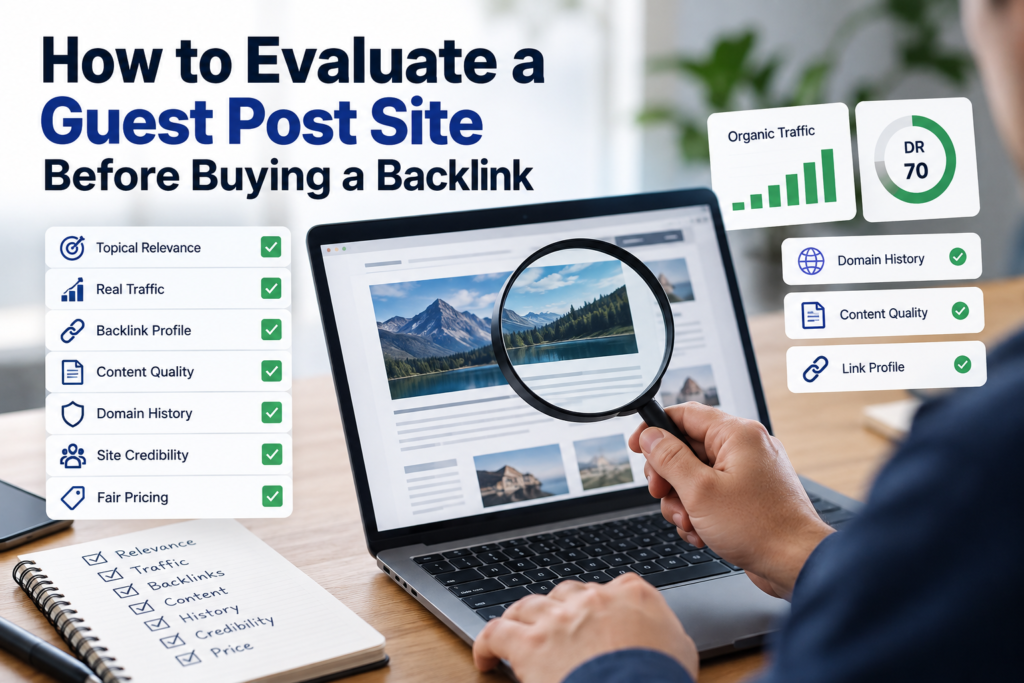
If you want to know how to evaluate a guest post site before buying a backlink, start by looking beyond Domain Rating.
A guest post site should not be approved because it has a high DR, and it should not be rejected simply because one metric looks mediocre. The real question is whether the publisher looks like a credible, relevant publication where your specific placement makes editorial sense.
The right question is:
Does this publisher look like a real, relevant publication where this particular placement makes editorial sense?
That requires looking at several signals together: topical relevance, organic visibility, traffic history, ranking keywords, backlink profile, editorial quality, outbound links, publishing behavior, site history and the actual page where your link will appear.
A DR 70 site with almost no meaningful search visibility, dozens of unrelated sponsored articles and aggressive commercial outbound links can be a much weaker opportunity than a DR 40 specialist publication with genuine rankings, focused coverage and consistent editorial standards.
The metric is a filter.
The publisher is the decision.
How to Evaluate a Guest Post Site: 12 Quality Checks
Before approving a publisher, check these areas:
- Topical relevance
- Organic traffic and traffic trend
- Ranking keyword quality
- DR or another authority metric
- Backlink profile
- Editorial quality
- Outbound-link behavior
- Publishing patterns
- Site and domain history
- Geographic relevance
- The actual proposed placement
- Commercial and post-publication terms
You do not need every publisher to be perfect.
You do need to understand why you are approving it.
That distinction becomes especially important for agencies evaluating dozens of domains from publisher lists or white-label fulfillment partners.
Stop Treating DR as a Quality Score
Domain Rating is useful.
But it answers a narrower question than many backlink buyers assume.
Ahrefs defines Domain Rating as a metric that measures the strength of a website’s backlink profile relative to other sites in its database. It is not a direct measurement of:
- readership;
- editorial quality;
- topical expertise;
- organic traffic;
- real-world brand authority;
- placement quality;
- whether a site exists mainly to sell links.
Ahrefs itself recommends considering factors such as backlink quality, organic traffic, topical relevance, content quality and outbound-link behavior rather than judging a link prospect on site-wide authority alone.
That makes DR useful for comparison and filtering, not final approval.
The same principle applies to Moz Domain Authority, Semrush Authority Score and other third-party metrics.
They can help you investigate a domain.
They cannot make the decision for you.
A simple test
Hide the DR column.
Now look at the site again.
Would you still consider it a credible publication for your client’s niche?
If the answer becomes an immediate no, the metric may be doing too much work in your decision.
The Mahwords Publisher Quality Framework
A practical way to evaluate publishers is to move through three gates.
Gate 1: Does the publication make editorial sense?
Check:
- topical relevance;
- site positioning;
- recent content;
- target audience;
- geographic fit;
- editorial consistency.
If the site makes no sense for the brand without looking at SEO metrics, investigate carefully before going further.
Gate 2: Does the site’s data support what it appears to be?
Check:
- estimated organic traffic;
- traffic history;
- ranking keywords;
- backlink profile;
- authority metrics;
- referring-domain patterns;
- outbound links;
- historical use of the domain.
The objective is not to find a perfect metric profile.
It is to find consistency.
A healthy-looking publisher should not require increasingly complicated explanations for why every important signal looks wrong.
Gate 3: Is this specific placement worth approving?
Check:
- proposed article topic;
- target URL;
- anchor;
- section of the site;
- placement type;
- content quality;
- link context;
- link attributes;
- publisher terms;
- post-publication support.
This final gate matters because a good domain can still produce a bad backlink.
Publisher quality and placement quality are related, but they are not the same thing.
Publisher evaluation is only one part of a broader link-building strategy that also includes target-page selection, anchor planning, acquisition methods and campaign sequencing.
1. Check Topical Relevance First
Start by looking at what the publication actually covers.
Not its category dropdown.
Not what the seller calls the niche.
Read recent articles.
Look at its strongest sections.
Ask:
- What topics does it publish repeatedly?
- Who appears to be the intended reader?
- Does the site have subject-matter depth?
- Would your proposed article look normal alongside its existing content?
- Does your target page have a reasonable connection to that audience?
A cybersecurity SaaS company does not automatically benefit from a link simply because the referring domain has a strong authority metric.
A focused technology, security, IT or B2B publication is usually easier to justify contextually than a general blog that publishes cybersecurity on Monday, recipes on Tuesday, casino content on Wednesday and home renovation on Thursday.
Broad publications are not automatically bad
Large legitimate publications frequently cover many subjects.
The question is whether there is a coherent editorial structure behind that coverage.
A major business publication may legitimately have technology, finance, leadership and marketing sections.
That is different from a domain with no discernible audience publishing whatever commercial topic someone pays it to accept.
Look for editorial logic rather than demanding artificially narrow niches.
2. Check Organic Traffic—but Don’t Stop at the Number
Estimated organic traffic is one of the most useful publisher-vetting signals because it can reveal whether a site currently has meaningful visibility in search.
But the headline number is only the beginning.
Suppose two sites each show 20,000 estimated monthly organic visits.
Site A gets traffic from hundreds of relevant industry articles.
Site B gets most of its traffic from three unrelated informational pages.
Those are not equivalent publishers.
Look at:
- current estimated traffic;
- 6–24 month traffic trend;
- top-performing pages;
- countries generating traffic;
- keyword distribution;
- whether traffic is spread across the site;
- whether the relevant section receives visibility.
Traffic estimates are estimates
Ahrefs, Semrush and Similarweb do not have access to every publisher’s private analytics.
Third-party traffic numbers should therefore be used comparatively rather than treated as exact audience counts.
If Ahrefs estimates 12,000 visits and Semrush estimates 19,000, that does not automatically mean one tool is wrong.
The more important question is whether both sources tell approximately the same story:
Is this an active site with meaningful visibility, or a domain whose authority metrics are disconnected from current search performance?
Look at the trend
A current traffic number can hide important history.
A publisher with 25,000 estimated visits today might have:
- grown steadily from 8,000;
- remained stable around 25,000 for years;
- fallen from 400,000;
- recovered after a major decline;
- gained most traffic during one short spike.
Those scenarios deserve different interpretations.
A decline does not automatically disqualify a site.
Sites lose traffic for many legitimate reasons:
- rankings shift;
- seasonal demand changes;
- content becomes outdated;
- SERP features reduce clicks;
- business priorities change.
But a severe unexplained decline is worth investigating before paying for a placement.
3. Examine What the Site Actually Ranks For
Traffic quality is often more useful than traffic quantity.
Open the site’s ranking keywords or top organic pages.
Ask:
Does Google appear to understand this site roughly the same way the site’s branding describes it?
For a marketing publication, you would expect rankings around topics such as:
- SEO;
- content marketing;
- analytics;
- advertising;
- SaaS;
- digital PR;
- marketing operations.
If the site’s strongest keywords are unrelated to its supposed niche, investigate why.
Also look for strange patterns:
- thousands of irrelevant long-tail keywords;
- rankings concentrated around scraped content;
- traffic generated mostly by celebrity names;
- foreign-language pages unrelated to the site’s core audience;
- sudden keyword expansion into gambling, loans or other unrelated commercial categories.
The point is not that every ranking must match your niche.
It is whether the site’s organic footprint supports the idea that this is a genuine publication in the category you are buying.
4. Use DR as Context, Not the Decision
Once you understand relevance and traffic, authority metrics become more useful.
Compare DR with:
- organic traffic;
- referring domains;
- content footprint;
- age/history;
- niche competitors.
The combination matters more than any universal cutoff.
For example:
| Publisher | DR | Organic visibility | Initial interpretation |
|---|---|---|---|
| Site A | 72 | Near-zero search visibility | Investigate why authority and visibility diverge |
| Site B | 46 | Strong, stable niche traffic | Potentially attractive despite lower DR |
| Site C | 58 | Growing relevant traffic | Strong candidate for deeper review |
| Site D | 35 | Small but genuine specialist readership | May be useful for highly relevant campaigns |
These are hypothetical examples, not thresholds.
A DR 30 publication can be excellent.
A DR 70 publication can be poor.
What matters is what created the number and what else exists around it.
Mahwords will examine this relationship in more depth in the dedicated Domain Rating vs Organic Traffic article later in this cluster.
5. Audit the Publisher’s Own Backlink Profile
If you are buying a backlink partly because a domain appears authoritative, inspect how that domain acquired its own authority.
Look for:
- diversity of referring domains;
- recognizable industry links;
- editorial mentions;
- unusual sitewide backlinks;
- obvious network links;
- sharp unexplained referring-domain spikes;
- irrelevant foreign-language anchors;
- heavily commercial anchor text;
- groups of suspiciously similar domains.
You are not trying to prove that every backlink is perfect.
Almost every established domain has some strange links.
You’re looking for the difference between:
a naturally messy backlink profile
and
a profile whose authority appears to have been deliberately manufactured.
Pay attention to anchor text
A normal site usually accumulates plenty of:
- branded anchors;
- URL anchors;
- article-title anchors;
- natural descriptive phrases.
A domain dominated by aggressive commercial anchors deserves closer review.
Ahrefs specifically identifies unnatural anchor patterns and very large numbers of outgoing links as potential link-farm signals.
6. Inspect Outbound Links
This is one of the most overlooked checks.
A publisher may have:
- decent DR;
- legitimate history;
- organic traffic;
- well-designed pages;
and still have evolved into a high-volume paid-link operation.
Open recent articles and inspect who they link to.
Ask:
- Are external links editorially relevant?
- Do articles routinely contain commercial anchors?
- Are unrelated companies inserted into otherwise ordinary posts?
- Do most recent articles appear sponsored?
- Does the site link heavily to gambling, payday loans, adult content, questionable supplements or other unrelated verticals?
- Are outbound links concentrated around obvious SEO buyers?
- Does every article appear to contain exactly one commercial dofollow link?
One strange link proves very little.
A repeated pattern across dozens of posts tells you much more.
Outbound volume requires context
A large news or research site naturally links to many domains.
The problem is not simply “this site links out a lot.”
The problem is why, where and how it links out.
Ten citations to legitimate sources in a research article are fundamentally different from ten unrelated keyword-rich commercial links sold inside generic content.
7. Read the Content Like an Editor
Do not approve a publisher without reading several recent articles.
You are looking for signs that the publication has standards beyond accepting payment.
Check:
- writing quality;
- factual accuracy;
- article structure;
- editing;
- formatting;
- source citations;
- depth;
- topic selection;
- duplicated patterns;
- author information;
- obvious mass-production footprints.
Ask yourself:
Would I be comfortable showing this publication to the client without first explaining why its DR is high?
That question is useful because clients do not experience links as spreadsheet metrics.
They click them.
AI-generated content is not automatically the issue
The more important question is whether the content is useful, accurate and editorially controlled.
A weak site can publish human-written filler.
A legitimate publication can use AI somewhere in its workflow.
Evaluate the output and editorial behavior rather than trying to guess which tool produced every paragraph.
8. Look at Authors, Editors and Site Identity
Real publications usually give you some way to understand who is responsible for the site.
Look for:
- About page;
- editorial information;
- real author profiles;
- company identity;
- contact information;
- editorial policies;
- identifiable ownership where appropriate.
Absence of one element is not proof of a link farm.
But multiple credibility gaps can add up.
For example:
anonymous authors + no About page + no meaningful contact information + unrelated commercial articles + aggressive outbound links
is much more concerning than any one of those signals on its own.
Ahrefs similarly recommends reviewing author and About information when checking for link-farm characteristics.
9. Review the Publishing Pattern
Scroll through recent posts.
You are trying to understand the publication’s business model.
Healthy patterns may include:
- editorial articles;
- news;
- guides;
- interviews;
- product coverage;
- contributed pieces;
- occasional sponsored content.
Concerning patterns might include dozens of daily articles across unrelated commercial topics, each containing an unnatural outbound link.
Again, there is no magic ratio.
Sponsored content is a legitimate publishing model.
Advertising is a legitimate publishing model.
The issue is whether the site remains a publication with an audience—or has effectively become infrastructure for selling ranking links.
10. Check the Domain’s History
A domain can look respectable today while having a completely different history.
Use historical snapshots to investigate major changes.
The Internet Archive’s Wayback Machine can help you see what a domain looked like in previous years.
Questions worth asking:
- Did this domain always cover roughly this topic?
- Was it previously a different business?
- Was there a long period where the site disappeared?
- Did it suddenly transform into a multi-topic guest-post publication?
- Does the current content bear any relationship to the domain’s historical purpose?
This matters because expired domains can retain valuable backlinks from their previous use.
Google’s spam policies specifically address expired domain abuse: acquiring and repurposing expired domains primarily to manipulate search rankings with low-value content.
A change in ownership is not automatically a problem.
Buying an expired domain is not automatically spam.
The concern is the combination of historical authority + unrelated repurposing + low-value content designed to exploit that authority.
11. Check Geographic Relevance
A site can have substantial organic traffic and still be wrong for the campaign.
Suppose your client sells B2B software primarily in the United States.
A publisher with most of its search visibility in a market where the client does not operate may have less commercial relevance than its total traffic number suggests.
Check:
- primary traffic countries;
- language;
- audience;
- regional content;
- whether the publisher reaches the client’s actual market.
This matters particularly for Mahwords’ Tier-1 campaigns targeting the US, UK, Canada, Australia and Singapore.
Geography should not become another rigid rule.
A globally read specialist publication may still be excellent.
The question is whether the audience makes sense for the campaign.
12. Check Whether Important Pages Are Search-Visible
You want evidence that Google can discover and surface the publisher’s content.
Do not rely on a claimed “Google indexed pages” number from a seller.
Instead, sample the site.
Search for:
- the publication’s brand;
- exact titles of recently published articles;
- important sections;
- older articles.
You can also review whether the site’s articles appear in organic-data tools.
Be careful with conclusions here.
A public Google query is not a precise indexation audit.
You cannot use another publisher’s Google Search Console URL Inspection report unless you have access to that property.
Treat external indexation checks as signals, not definitive proof of Google’s internal index state.
13. Evaluate the Exact Page and Placement
This is where many otherwise good publisher evaluations fail.
The domain can be legitimate while the proposed placement is weak.
For a new guest post, ask:
- Is the proposed topic relevant?
- Which site section will contain it?
- Will the article be internally linked?
- Will it be accessible from the site architecture?
- Does the publisher intend to index it?
- Will the article remain live?
- Who controls edits?
- How will your link be placed?
For an existing-page insertion, also check:
- age of the page;
- current rankings;
- current organic traffic where available;
- topical fit;
- existing external links;
- whether your link genuinely improves the passage.
Do not buy a domain metric.
Buy—or earn—a sensible placement on a sensible page.
14. Review the Link Context and Anchor
A contextual link should make sense to someone who does not know there is an SEO campaign behind it.
Read the sentence around the proposed link.
Does the linked resource actually support or extend the point?
If removing the link makes the sentence obviously strange, the insertion may have been forced.
Be especially careful with repetitive commercial exact-match anchors.
Google’s current spam policies explicitly identify buying or selling links for ranking purposes as link spam and include paid guest-post links with optimized anchor text among its examples.
Google states that paid links used for advertising or sponsorship should be appropriately qualified with rel="sponsored" or nofollow.
That is Google’s documented policy.
It is separate from the common SEO-industry practice of buying followed placements.
A high-quality publisher evaluation does not turn a paid followed backlink into a Google-approved tactic.
These are two different questions:
- Is this a credible publisher and placement?
- Does the way the link is acquired comply with Google’s policies?
Do not collapse them into one.
15. Compare Price With Quality—Not Just DR
The cheapest publisher is not automatically bad.
The most expensive publisher is not automatically good.
Price may reflect:
- publisher demand;
- site authority;
- niche;
- traffic;
- geography;
- editorial workload;
- content requirements;
- turnaround;
- reseller layers;
- commercial positioning.
That is why a publisher list ordered only by:
DR → price
is a weak buying system.
A better decision considers:
relevance + visibility + editorial quality + backlink profile + placement quality + commercial terms.
Mahwords’ upcoming guest-post pricing guide will examine the pricing side separately rather than pretending there is one universal “fair price.”
Hard Red Flags vs Signals to Investigate
Not every imperfect metric should trigger rejection.
Separate serious patterns from things that simply deserve investigation.
| Signal | Typical response |
|---|---|
| Completely unrelated content across many commercial niches | Strong red flag |
| Obvious PBN/network footprint | Strong red flag |
| Site appears built primarily to sell SEO links | Strong red flag |
| Repurposed expired domain with unrelated low-value content | Strong red flag |
| Extremely aggressive commercial outbound linking | Strong red flag |
| High DR but very little organic visibility | Investigate |
| Recent traffic decline | Investigate |
| Small specialist site with modest DR | Not automatically negative |
| Low traffic in a very narrow B2B niche | Context-dependent |
| Broad publication covering multiple legitimate sections | Context-dependent |
| Sponsored content mixed with genuine editorial content | Context-dependent |
| One questionable article | Investigate the wider pattern |
| Lower DR but strong niche relevance | Potentially attractive |
This is why binary rules such as:
“Never buy below DR 50”
or
“Never use a site below 10,000 traffic”
are weak publisher-vetting policies.
They are easy to put in a spreadsheet.
They are not necessarily good editorial judgment.
A Practical 10-Minute Publisher Review
If you need to know how to evaluate a guest post site quickly without reducing the decision to DR or traffic alone, use a two-stage review process.
Stage 1: Fast rejection pass
Spend the first few minutes on:
1. Relevance
Does the publication genuinely cover the client’s niche or an adjacent subject?
2. Traffic
Does the domain have meaningful current organic visibility?
3. Traffic trend
Is visibility stable, growing or explainably declining?
4. Content
Do recent articles look useful and edited?
5. Outbound links
Is there an obvious paid-link footprint?
6. Site identity
Does this resemble a real publication or identifiable business?
If the site fails badly at several of these, stop.
Do not spend another 20 minutes trying to convince yourself that the DR makes up for it.
Stage 2: Deep review
For survivors, inspect:
- top organic pages;
- ranking keywords;
- backlink profile;
- referring domains;
- anchor profile;
- historical snapshots;
- recent outbound links;
- proposed article/page;
- target-country traffic;
- placement terms;
- link attributes;
- replacement conditions.
This keeps quality control practical even when working with large publisher lists.
A Publisher Approval Scorecard
Mahwords does not recommend reducing every publisher to one artificial quality score.
A better approach is a decision matrix.
Use:
PASS — supports approval
CHECK — needs investigation
REJECT — unacceptable for this campaign
| Area | PASS | CHECK | REJECT |
|---|---|---|---|
| Topical relevance | Clear fit | Adjacent/general | Unrelated |
| Organic visibility | Meaningful and credible | Limited/declining | Essentially disconnected from claimed authority |
| Traffic trend | Stable/growing | Declining | Severe unexplained collapse plus other warning signs |
| Ranking keywords | Relevant to site identity | Mixed | Dominated by unrelated/spam topics |
| Authority profile | Natural enough to support metrics | Some anomalies | Obvious manipulation/network pattern |
| Editorial quality | Consistent and useful | Uneven | Thin/mass-produced |
| Outbound links | Contextual/relevant | Mixed | Aggressive unrelated commercial pattern |
| Site identity | Clear | Limited | Multiple credibility gaps |
| History | Consistent | Changed ownership/topic | Obvious authority repurposing pattern |
| Placement | Natural contextual fit | Needs adjustment | Forced/unrelated |
A publisher with eight passes and two checks may be perfectly reasonable.
A publisher with a huge DR but five rejects should not be rescued by the metric.
What Mahwords Looks for in Publisher Opportunities
At Mahwords, publisher selection is not based on one metric.
Our current service model considers signals such as:
- verified organic visibility in third-party SEO tools;
- domain authority metrics;
- topical relevance;
- editorial activity;
- backlink-profile quality;
- content relevance;
- publisher behavior;
- fit with the target campaign.
The agency or client can review publisher opportunities before content is written or a placement is completed.
That pre-approval step matters because different campaigns require different tradeoffs.
A specialist B2B SaaS publication with moderate authority may be a better fit for one campaign.
A larger technology or business publication may make more sense for another.
There is no universal “best guest post site.”
There is only a stronger or weaker fit for a particular campaign.
Publisher Quality Is a Pattern, Not a Number
The best publisher decisions usually become obvious when you stop looking for one perfect metric.
A strong opportunity tends to tell a coherent story:
The site covers the right subject.
Its content looks legitimate.
It earns visibility for relevant queries.
Its traffic history makes sense.
Its backlinks make sense.
Its outbound links make sense.
Its history makes sense.
And your proposed placement makes sense within it.
Weak opportunities often require you to ignore several contradictions because one number looks attractive.
That is exactly what publisher vetting is supposed to prevent.
If you are evaluating sites at scale, use metrics to narrow the list.
Then use editorial judgment to make the decision.
Need publisher options that have already been screened for relevance, traffic and editorial quality? Request vetted publisher options from Mahwords before committing to a placement.
Frequently Asked Questions
How to evaluate a guest post site before buying a backlink?
Start with topical relevance, then review organic traffic, traffic history, ranking keywords, authority metrics, backlink quality, editorial standards, outbound links, site history and the actual proposed placement. Do not approve a site based on DR or DA alone.
What is a good Domain Rating for guest posting?
There is no universal good DR. A suitable DR depends on the niche, campaign, competitors and other quality signals. A lower-DR specialist publication with real traffic and strong relevance can be more attractive than a higher-DR site with weak visibility or questionable publishing patterns.
How much organic traffic should a guest post site have?
There is no universal minimum that works across every niche. A narrow B2B publication may naturally receive less traffic than a general consumer publication. Examine traffic relative to the site’s niche, authority, history and ranking keywords rather than applying one arbitrary threshold.
Is DR or organic traffic more important for backlinks?
They measure different things. DR primarily reflects backlink-profile strength, while estimated organic traffic indicates search visibility. Neither should be used alone. The strongest evaluation considers relevance, traffic, authority, content quality and the actual placement together.
How can you tell if a guest post site is a link farm?
Common warning signs include unrelated content across many niches, poor editorial quality, anonymous or weak site identity, aggressive commercial outbound links, unnatural anchor patterns, questionable backlink profiles and authority metrics that do not align with organic visibility.
Is buying a guest post against Google’s guidelines?
Google’s spam policies say buying or selling links for ranking purposes is link spam. Google allows paid advertising and sponsorship links when they are appropriately qualified with rel="sponsored" or nofollow. Whether a publisher is high quality is therefore separate from whether a particular paid-link arrangement complies with Google’s documented policies.
Should I reject every site that has lost organic traffic?
No. Traffic declines require investigation, not automatic rejection. Determine the scale, timing, affected pages and whether other signals remain healthy. A temporary or explainable decline is different from a long-term collapse combined with poor content and suspicious link behavior.