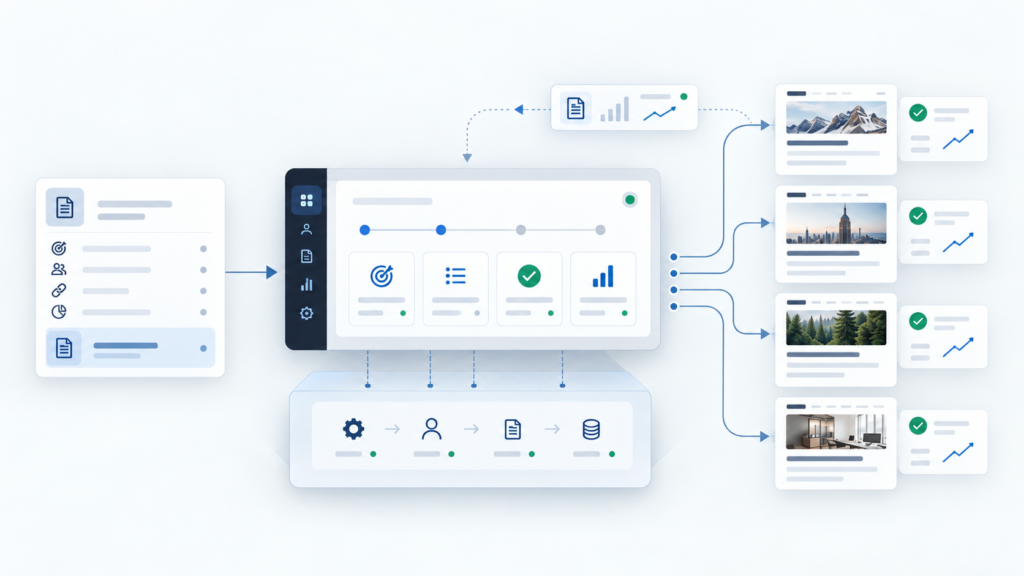
White-label link building lets an SEO or digital marketing agency offer link acquisition under its own brand while a specialist partner handles some or all of the fulfillment behind the scenes.
The agency keeps the client relationship, commercial strategy, pricing and usually final approval. The fulfillment partner can handle publisher sourcing, outreach, negotiation, content coordination, placements, quality checks and delivery.
Done well, it gives an agency more link-building capacity without building an entire outreach operation internally.
Done badly, it simply moves the agency’s quality-control problem to a third party.
That distinction matters.
A white-label provider should not be a black box that sends a spreadsheet of links at the end of the month. The strongest model gives the agency clear control points before publication, transparent publisher information, defined quality standards and reporting that can be incorporated into the agency’s existing client workflow.
What Is White-Label Link Building?
White-label link building is a fulfillment arrangement in which a specialist provider acquires or coordinates backlinks for an agency’s clients while the agency remains the client-facing brand.
The provider works behind the scenes.
The agency sells and manages the service.
A typical arrangement looks like this:
Client → SEO agency → white-label fulfillment partner → publishers
The agency remains responsible for what the client sees.
The fulfillment partner manages the operational layer the agency does not want to build or scale internally.
That may include:
- publisher research and sourcing;
- outreach and publisher communication;
- negotiating placement requirements;
- coordinating guest-post content;
- arranging contextual link insertions;
- confirming anchors and target URLs;
- checking the finished placement;
- delivering live URLs and campaign data;
- handling agreed post-publication support.
White-label fulfillment is therefore different from simply buying random backlinks from a marketplace. The objective is not merely to obtain URLs. It is to add backend capacity without giving up the agency’s standards, client relationship or brand.
Who Is White-Label Link Building For?
White-label fulfillment makes the most sense when an agency has link-building demand but does not want every operational function sitting in-house.
Common situations include an agency that:
- sells SEO but does not have a dedicated outreach team;
- has more client work than its existing link team can handle;
- wants to add link building to its service mix;
- needs publisher capacity in niches its internal team does not cover;
- wants variable fulfillment costs rather than expanding headcount immediately;
- needs additional publisher relationships without managing each relationship directly;
- wants to test a link-building offer before building a permanent internal department.
It can also work as overflow capacity.
An agency may already have excellent in-house link builders but still use an external partner when campaign volume spikes, a new niche requires different publisher relationships, or delivery deadlines exceed internal capacity.
White label does not have to mean replacing the internal team.
It can simply mean adding another fulfillment layer.
What Should the Agency Keep Control Of?
One of the biggest mistakes in outsourced link building is outsourcing decisions that should remain strategic.
A fulfillment partner can execute the campaign, but the agency should still understand what is being executed and why.
| Agency should normally retain | Fulfillment partner can handle |
|---|---|
| Client relationship | Publisher sourcing |
| Overall SEO strategy | Prospect research |
| Commercial pricing | Publisher outreach |
| Target-page priorities | Publisher negotiation |
| Client risk tolerance | Content coordination |
| Quality requirements | Guest-post fulfillment |
| Final publisher approval where applicable | Link-insertion coordination |
| Anchor governance | Placement logistics |
| Client communication | Initial placement QA |
| Final client reporting narrative | Live-URL and placement data |
| Campaign-level performance decisions | Agreed replacement/support workflow |
The exact division can change.
Some agencies want a provider to make anchor recommendations. Others provide every anchor themselves.
Some outsource content completely. Others supply finished articles.
Some want a shortlist of publishers before anything moves forward. Others approve broader criteria and let the provider conduct custom outreach before presenting opportunities.
What matters is that these responsibilities are deliberately assigned rather than assumed.
Strategy should not disappear when fulfillment is outsourced
A white-label partner can source and place links.
It should not automatically decide which pages on your client’s site deserve authority, how aggressive anchor usage should be, or how the link program fits the client’s wider organic-search strategy unless that strategic responsibility is explicitly part of the engagement.
Those decisions affect far more than fulfillment.
For a broader view of how different acquisition methods fit together, Mahwords’ Complete Guide to Link Building in 2026 explains the wider strategic layer.
How White-Label Link Building Works Step by Step
A strong workflow creates approval points before problems become expensive.
1. The agency defines the campaign
The agency starts with the client objective.
That brief may include:
- client domain;
- niche;
- target URL or URLs;
- target geography;
- desired placement type;
- preferred authority or traffic ranges;
- topical requirements;
- prohibited niches;
- anchor requirements;
- budget;
- required volume;
- expected delivery window.
A weak brief produces weak fulfillment.
“Give me ten DR 50 links” is not much of a strategy.
A useful brief tells the provider what type of site makes sense for the client’s market and target page.
2. The fulfillment partner sources publishers
This can happen in two different ways.
Inventory-led fulfillment starts with publisher relationships or available opportunities the provider already knows.
Custom outreach starts with prospect research and outreach based on the client’s specific niche and requirements.
Neither model is automatically superior.
Inventory can make availability and commercial terms easier to confirm.
Custom outreach can expand the potential publisher pool and reduce dependence on a fixed catalogue.
An agency should know which model it is buying.
3. Publishers are evaluated against the brief
This is where quality control begins.
Publisher evaluation should extend beyond a single authority metric.
Useful signals include:
- topical relevance;
- estimated organic traffic;
- traffic trend;
- ranking-keyword quality;
- editorial activity;
- article quality;
- backlink profile;
- outbound-link behaviour;
- publishing patterns;
- site history;
- geographic relevance;
- placement context;
- indexation and crawlability.
Domain Rating can be useful, but it is not a quality verdict. Ahrefs itself defines DR as a measure of backlink-profile strength and warns against using it as a standalone indicator of website quality.
This distinction becomes especially important when an agency is reviewing dozens or hundreds of publisher options.
4. The agency approves the opportunity
Approval workflow is one of the biggest differences between providers.
In an inventory-based model, the agency may be shown the exact publication, metrics and commercial terms before fulfillment.
In a custom-outreach model, the agency may first approve campaign criteria, then review a publisher after the publisher has responded positively.
Either can work.
The dangerous version is a campaign with no meaningful approval point at all, where the agency discovers the publisher only after the link has gone live.
That leaves the agency responsible to its client for a placement it never chose.
5. Content is produced or supplied
For a guest post, someone needs to produce content that satisfies both the campaign and the publisher.
There are usually three options:
- the agency supplies the article;
- the fulfillment partner produces it;
- the publisher controls or substantially edits the content.
Clarify this before ordering.
Also clarify:
- who owns the draft;
- whether the agency can review it;
- whether edits are included;
- whether publisher revisions are expected;
- whether the publisher can change the headline or structure;
- how the target link and anchor are handled.
Content is not just packaging for a backlink.
If the article looks like it exists solely to carry a commercial link, that creates both editorial and search-policy concerns.
6. The publisher publishes the placement
After approval and content coordination, the piece goes live.
The provider should verify more than whether the URL exists.
Check:
- correct target URL;
- correct anchor;
- correct article;
- placement context;
- agreed link attribute;
- page accessibility;
- canonical behaviour where relevant;
- obvious post-publication changes.
The client should not be the first person to discover that the wrong URL was linked.
7. The agency receives client-ready data
At minimum, the delivery record should make it easy to answer:
What was placed, where, when and for which target?
Useful fields include:
| Reporting field | Why it matters |
|---|---|
| Live publication URL | Lets the agency verify the placement |
| Publisher/domain | Identifies the referring site |
| Target URL | Confirms the correct client page |
| Anchor text | Confirms implementation |
| Publication date | Tracks campaign chronology |
| Placement type | Distinguishes guest post, insertion, PR, etc. |
| Publisher metrics | Provides evaluation context |
| Status | Makes active/dropped/replaced links visible |
| Notes | Records publisher or campaign exceptions |
White-label reporting does not necessarily require sophisticated software. A well-structured unbranded spreadsheet may be enough.
For agencies with larger client rosters, platforms such as AgencyAnalytics can also provide agency-branded reports and dashboards with custom logos, brand colours and, depending on configuration, branded domains.
The reporting layer should fit the agency’s workflow rather than force the agency to redesign its client experience around the vendor.
8. Post-publication support begins
A placement going live is not always the end of the transaction.
Pages can disappear.
Publishers can edit content.
URLs can change.
Links can be removed.
Attributes can change.
That makes replacement and support terms important—especially when an agency is reselling the work to a client.
Before ordering, understand:
- what qualifies for replacement;
- how long the replacement window lasts;
- whether removal or attribute changes are covered;
- whether an alternative publisher may be substituted;
- whether refunds are ever available;
- what events are excluded.
Do not confuse replacement support with guaranteed SEO outcomes.
A provider can monitor whether a link remains live.
It cannot guarantee that Google will index a page, preserve an index entry, improve a ranking or generate a specific amount of organic traffic.
Guest Posts vs Link Insertions in White-Label Fulfillment
Two common fulfillment products are guest posts and link insertions, often called niche edits.
They solve different operational problems.
| Area | Guest post | Link insertion / niche edit |
|---|---|---|
| Content | New article is published | Link is added to an existing article |
| Content control | Usually higher | Usually lower |
| Page history | New URL | Existing URL may already have history |
| Turnaround | Requires writing/editorial workflow | Can be faster where suitable inventory exists |
| Context | Built around new content | Must fit existing context naturally |
| Publisher approval | Article/topic often reviewed | Existing-page change must be approved |
| Best use | New topical coverage and editorial placements | Contextual opportunities on relevant existing pages |
Neither format should be chosen purely because it is easier to sell.
The right format depends on the client, target page, publisher and placement context.
A dedicated comparison of guest posts vs niche edits should go deeper into that decision rather than treating one as universally superior.
White-Label Link Building vs White-Label SEO
These terms are related but not interchangeable.
White-label link building is specifically about off-page acquisition and publisher fulfillment.
White-label SEO can cover a much wider scope, including:
- technical audits;
- keyword research;
- on-page optimization;
- content;
- local SEO;
- link building;
- reporting;
- account support.
An agency may outsource its entire SEO operation to a white-label provider.
Or it may retain technical SEO, content strategy and client management internally while outsourcing only link acquisition.
For many agencies, the narrower arrangement provides more control.
In-House vs White-Label Link Building
The right model depends on what the agency is trying to optimize.
| Area | In-house link building | White-label fulfillment |
|---|---|---|
| Day-to-day control | Highest | Depends on provider workflow |
| Hiring requirement | Requires internal capacity | Reduced |
| Publisher relationships | Built internally | Accessed through partner |
| Fixed overhead | Generally higher | More variable |
| Ramp-up | Team/process must be developed | Existing infrastructure can be used |
| Scaling volume | Requires more capacity | Can scale with partner capacity |
| Client branding | Fully controlled | Should remain agency-controlled |
| Quality responsibility | Internal | Shared operationally, but agency remains accountable to client |
| Dependency risk | Staff/process dependency | Vendor dependency |
| Knowledge retention | Stays inside agency | Some operational knowledge sits with partner |
White-label fulfillment does not eliminate operational risk.
It changes where that risk sits.
An agency trading fixed internal overhead for an external partner is also introducing supplier dependency.
That is why partner selection matters so much.
How Much Does White-Label Link Building Cost?
There is no credible universal price for white-label link building.
Current providers use several models, including per-placement pricing, metric or traffic tiers, managed campaigns and negotiated volume arrangements.
Actual cost can change based on:
- publication;
- niche;
- organic traffic;
- perceived authority;
- geographic market;
- content requirements;
- placement type;
- turnaround;
- volume;
- publisher commercial terms.
A link-building provider that publishes one flat price may simply be standardizing the inventory around that price point.
A custom fulfillment partner may quote every publisher differently.
Neither model is inherently wrong, but agencies should understand what the price represents.
Common pricing structures
Per-placement pricing
The agency pays for each completed publisher placement.
This is easy to understand and works well for small tests or irregular demand.
Tier-based pricing
Publishers are grouped according to criteria such as DR, traffic or another quality tier.
This makes quoting easier but can encourage agencies to treat a metric as the product.
Managed monthly fulfillment
The agency purchases an ongoing campaign or monthly capacity rather than individual URLs.
This can work better when the fulfillment partner also manages strategy, prospecting and recurring outreach.
Volume or partner pricing
Agencies with recurring requirements may receive different commercial terms from one-off buyers because the partner can plan around predictable volume.
The upcoming Mahwords guest-post pricing guide will examine publisher-level pricing in more detail.
How Agencies Should Think About Margin
White-label fulfillment allows an agency to separate its client price from its fulfillment cost.
But margin is not simply:
client price minus backlink cost.
A more useful calculation is:
Client revenue
− fulfillment cost
− account-management cost
− strategy/QA time
− reporting/tooling cost
− expected support or replacement cost
= contribution margin
This matters because the agency is still doing valuable work even if another company fulfills the links.
The agency may be responsible for:
- winning the client;
- building the SEO strategy;
- choosing target pages;
- approving publishers;
- communicating results;
- handling client questions;
- taking reputational responsibility for the campaign.
Selling a placement for exactly what the fulfillment partner charges would ignore that work.
At the same time, adding a markup to poor inventory does not transform it into a premium service.
Quality has to come first.
Quality Control Is the Core White-Label Problem
Scale is easy to sell.
Consistent quality is harder.
A provider can have thousands of available publishers and still be a poor fit if most of those sites have weak relevance, questionable traffic, poor editorial standards or obvious paid-link footprints.
The agency needs a repeatable evaluation system.
Do not buy DR in isolation
Ahrefs’ Domain Rating measures the relative strength of a site’s backlink profile. It does not directly measure:
- editorial quality;
- real readership;
- subject relevance;
- publisher legitimacy;
- traffic quality;
- whether the specific linking page is useful.
That is why DR vs organic traffic deserves its own analysis.
A good publisher review combines multiple signals rather than letting one third-party number make the decision.
Check the site, not only the spreadsheet
Metrics should narrow the list.
Human review should make the decision.
Look at what the publisher actually publishes.
Ask:
- Does the site have a coherent subject?
- Are recent articles useful?
- Does it publish unrelated commercial topics constantly?
- Who writes or edits the content?
- Does organic visibility appear stable?
- Are outbound links relevant or indiscriminate?
- Does the proposed article fit the site’s normal editorial coverage?
- Would the link still make sense if SEO metrics were hidden?
If the answer to the last question is no, the placement deserves more scrutiny.
The next Mahwords article in this cluster—How to Evaluate a Guest Post Site Before Buying a Backlink—will turn this into a complete publisher-evaluation framework.
What Should White-Label Reporting Include?
A client does not need to see the fulfillment supply chain.
But the agency should.
A strong fulfillment report should give the agency enough data to independently verify the work.
At minimum:
- publisher;
- live URL;
- client target URL;
- anchor;
- publication date;
- placement type;
- relevant site metrics;
- status.
Agencies can then incorporate those fields into their own reporting environment.
For some teams, a Google Sheet is enough.
For larger agencies, a branded reporting platform can centralize SEO data alongside campaign notes and placement records.
What matters is traceability.
“Five links delivered” is not useful reporting.
“Here are the five live pages, their targets, anchors, dates and relevant publisher data” is.
What Should a Replacement Policy Cover?
Replacement policy is often treated as a sales bullet.
It should be treated as an operational contract term.
Clarify what happens if:
- the page is deleted;
- the link disappears;
- the publisher changes the target URL;
- the agreed link attribute changes;
- the domain goes offline;
- the page becomes inaccessible;
- the publisher removes the article.
Also clarify what is not covered.
Indexing is a good example.
A provider may help check or troubleshoot whether a live placement is indexed, but search-engine indexing is ultimately outside the provider’s control.
An agency should be suspicious of absolute guarantees involving rankings, traffic or permanent indexation.
Does White-Label Link Building Violate Google’s Guidelines?
White labeling itself is a fulfillment model.
Google’s policies focus on how links are created and whether they are intended to manipulate rankings, not whether the person conducting outreach is an employee or an external supplier.
This distinction matters.
Google’s current spam policies list buying or selling links for ranking purposes as link spam. The examples include exchanging money for links or posts containing links, as well as advertorials or native advertising where payment is received for links that pass ranking credit. Google also specifically identifies optimized anchor text in paid guest posts and similar distributed content as problematic.
For paid placements, Google’s outbound-link documentation recommends rel="sponsored". nofollow is still accepted for this purpose, although Google says sponsored is preferred.
That is Google’s documented position.
Industry practice is not always identical.
Agencies and publishers use many different commercial models, and some paid placement markets sell followed links specifically for SEO purposes.
That does not change the documented policy.
An agency evaluating any fulfillment provider should understand:
- how the link was obtained;
- whether compensation was involved;
- what attribute the publisher will use;
- what the provider is promising;
- what level of policy risk the agency and client are willing to accept.
Avoid blanket claims such as “paid backlinks are safe” or “all guest posts violate Google’s guidelines.”
Both statements remove important context.
Red Flags When Choosing a White-Label Link-Building Provider
The entire sales pitch is based on DR or DA
Authority metrics are useful filters.
They are not substitutes for publisher quality.
You cannot see meaningful publisher information
A provider does not always need to reveal every relationship before custom outreach starts.
But an agency should have enough visibility to evaluate a placement before it becomes a client deliverable.
The inventory covers every imaginable niche with no obvious editorial logic
Large inventories are not inherently bad.
But a site publishing SaaS, casino, health supplements, mortgages, pets and home renovation indiscriminately deserves scrutiny regardless of its headline metrics.
Every placement is guaranteed to be followed, indexed and permanent
A provider does not control Google’s index.
And truly independent publishers can change pages or policies.
Ask what is controlled, what is monitored and what is only an expectation.
There is no written replacement policy
If a link disappears, you should already know what happens next.
Content is treated as disposable
Poor content can create obvious commercial footprints and make placements less useful to readers.
The provider cannot explain how publishers are vetted
“High DR” is not a vetting process.
Reporting is impossible to verify
An agency should receive live URLs, not screenshots or vague placement totals.
The provider pressures you to buy volume before testing the workflow
A small paid test can reveal more about quality, communication and reporting than a sales deck.
Provider Evaluation Checklist
Before committing significant client volume, ask these questions.
| Area | What to ask |
|---|---|
| Publisher quality | What criteria cause you to reject a publisher? |
| Relevance | How do you determine whether a site fits my client’s niche and target page? |
| Traffic | Which data sources do you use, and do you review trends? |
| Approval | At what point can my agency approve or reject the publisher? |
| Content | Who writes it, who reviews it and can we supply our own? |
| Links | How are anchors, targets and attributes confirmed? |
| Reporting | Do we receive live URLs and campaign-level data? |
| Branding | Will any supplier branding appear in client-facing deliverables? |
| Communication | Who manages issues, revisions and delayed publishers? |
| Replacement | What events trigger replacement and for how long? |
| Scale | Can quality standards remain client-specific as volume increases? |
| Policy | How do you handle paid placements and link attributes? |
| Confidentiality | Will the provider contact the end client? |
| Commercial terms | Are content, revisions and publisher fees included? |
The goal is not to find a provider with the longest list of guarantees.
It is to find one whose workflow is transparent enough that your agency can understand what it is reselling.
When Should an Agency NOT Outsource Link Building?
White label is not automatically the correct model.
Keep more of the function in-house when:
Link building is your agency’s core intellectual property
If clients hire your agency specifically because of your proprietary outreach process, journalist relationships or named link-building team, outsourcing most of the operation may weaken the thing clients are buying.
The campaign requires direct strategic relationships
Some digital PR and high-level editorial campaigns depend on relationships between the brand, agency and journalist.
Adding an invisible fulfillment layer can make those relationships harder rather than easier.
You cannot define your quality standards
A partner cannot reliably meet requirements you have never established.
If the agency cannot explain what a good publisher, acceptable anchor or suitable placement looks like, outsourcing will magnify that ambiguity.
You are outsourcing accountability
A provider can execute.
Your agency is still responsible for what it sells to the client.
If the plan is simply to blame the vendor whenever a weak placement goes live, the operating model is already broken.
What White-Label Fulfillment Looks Like at Mahwords
Mahwords approaches white-label fulfillment as a publisher-side operational layer rather than a replacement for the agency-client relationship.
The agency keeps the client.
It can also retain its own pricing, communication and campaign strategy.
The Mahwords workflow is built around:
- Campaign requirements — niche, target URL, preferred metrics, placement type, budget and expected volume.
- Publisher sourcing — available opportunities are filtered around the campaign rather than sending an undifferentiated site list.
- Pre-approval — the agency can review publisher options, relevant metrics and pricing before fulfillment.
- Content flexibility — the agency can supply its own article or use Mahwords for content where needed.
- Placement coordination — publisher-side requirements and delivery are managed behind the scenes.
- Live-URL verification — the completed placement and relevant details are delivered for verification.
- Post-publication support — monitoring and indexing support can be provided where applicable, without pretending rankings or indexation can be guaranteed.
- Recurring fulfillment — the same model can be used for a one-off paid test or ongoing volume.
For agencies, the objective is simple:
keep control of the client relationship while removing the publisher-management workload.
If that is the part of your delivery stack creating friction, you can request publisher options from Mahwords before committing to a larger campaign.
Frequently Asked Questions
What is white-label link building?
White-label link building is an arrangement where a specialist provider handles backlink acquisition or publisher fulfillment for an SEO or marketing agency while the agency presents the service under its own brand and keeps the client relationship.
How does white-label link building work?
The agency defines the client strategy and campaign requirements. The fulfillment partner then handles agreed operational work such as publisher sourcing, outreach, content coordination, placement and reporting. The agency reviews the deliverables and presents them to the client.
Is white-label link building suitable for SEO agencies?
It is most useful for agencies that sell SEO but lack dedicated link-building capacity, need overflow support, want access to additional publisher relationships or want to add link building without immediately hiring an internal outreach team.
How much does white-label link building cost?
There is no universal price. Cost depends on the publisher, niche, organic traffic, authority, placement type, content requirements, geography, turnaround and campaign volume. Providers may charge per placement, by quality tier, through monthly campaigns or through negotiated volume pricing.
Can agencies resell link-building services?
Yes. That is the basic commercial model behind white-label fulfillment: the agency purchases or contracts fulfillment, packages the service within its own offer and sets its own client pricing. The agency should account for strategy, account management, QA, reporting and commercial risk when calculating its margin.
What should an agency check before choosing a white-label provider?
Review publisher-vetting standards, approval workflow, content process, traffic and relevance criteria, reporting, replacement terms, confidentiality, communication, scalability and how the provider handles paid placements and Google’s link policies.
What is the difference between white-label SEO and white-label link building?
White-label SEO may include technical SEO, keyword research, content, on-page optimization, local SEO, reporting and link building. White-label link building is narrower: it focuses specifically on off-page acquisition, outreach and publisher fulfillment.
Is white-label link building safe?
The outsourcing model itself is not what determines search-policy risk. The acquisition method does. Google considers buying or selling links for ranking purposes link spam and recommends qualifying paid links with rel="sponsored" or nofollow. Agencies should understand how every provider obtains links rather than assuming that “white label” means either safe or unsafe.
The Question to Ask Before You Outsource
The decision is not really:
Should we outsource link building?
It is:
Which parts of link building can we outsource without giving up strategic control or lowering the quality our clients expect?
For many agencies, publisher sourcing, outreach, negotiation, content coordination and placement management are sensible functions to externalize.
Client strategy, standards, approval and accountability are not.
When that division is clear, a white-label partner can become genuine fulfillment infrastructure instead of another vendor that needs constant supervision.
Need additional publisher capacity for a client campaign? Request publisher options from Mahwords and review the fit before committing to larger volume.