Guest posts vs niche edits is not really a choice between a “good” link and a “bad” link. Both can produce useful contextual backlinks, and both can produce weak placements.
The real difference is how the link gets its context.
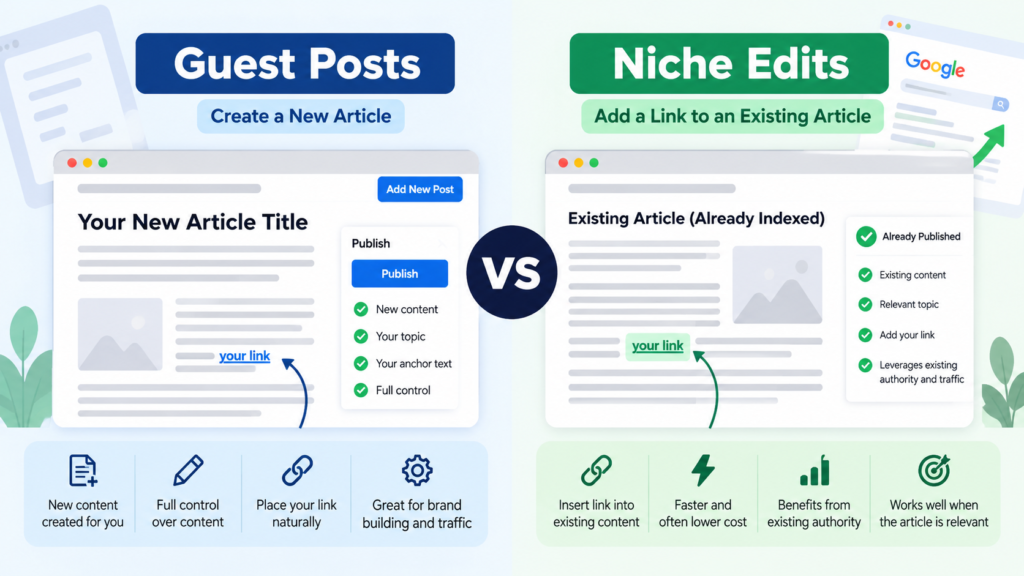
A guest post creates a new page around the link. A niche edit adds the link to a page that already exists.
That single difference changes almost everything else: content control, speed of fulfillment, page history, existing traffic, anchor flexibility, brand visibility, cost, and the type of quality checks you need to perform.
The practical answer: use guest posts when you need to create the context around the link. Use niche edits when a strong existing page already provides the context you need. In many campaigns, the best answer is a deliberate mix of both.
Guest Posts vs Niche Edits: The Quick Comparison
| Factor | Guest Post | Niche Edit |
| What happens | A new article is created and published | A link is added to an existing article |
| Content control | Usually higher | Usually lower |
| Page history | Starts fresh | Existing page may already have age, links, rankings or traffic |
| Operational speed | Usually slower because content must be created and approved | Often faster because no new article is required |
| Brand visibility | Higher potential | Usually lower |
| Anchor/context flexibility | Higher | Must fit existing copy naturally |
| Page-level due diligence | Important | Critical |
| Best fit | New topical coverage, brand visibility, controlled context | Strong existing pages with a natural reason to add your resource |
Neither column is automatically better. The quality of the publisher and the specific page still matter more than the label attached to the placement.
What Is a Guest Post?
A guest post is a new article published on another website that includes a contextual link to your site.
The article may be written by your team, a link-building provider, the publisher, or a writer working on behalf of the campaign. The publisher then reviews and publishes it according to its own standards.
- choose a topic that fits the publication;
- create a new article around that topic;
- place the target link naturally inside the article;
- coordinate revisions and publisher approval;
- publish a new URL on the host site.
Guest posting therefore buys more than a link. It also buys the opportunity to create the page that will contain the link.
What Is a Niche Edit?
A niche edit—also called a link insertion or contextual edit—adds your backlink to an article that is already published. Programming Insider’s explanation of niche edits describes the same core mechanic: instead of creating a new guest post, the link is placed into existing content where it can fit contextually.
The page may already have:
- indexing and crawl history;
- organic rankings;
- estimated search traffic;
- internal links;
- external backlinks;
- user engagement and historical performance.
Those existing signals are the main reason niche edits can be attractive. But they also create a different due-diligence problem: you are inheriting the page as it already exists.
The Real Difference: You Create Context or Inherit It
This is the most useful way to think about guest posts vs niche edits.
Guest post: you create the surrounding context.
Niche edit: you inherit the surrounding context.
With a guest post, you can usually shape the topic, section, examples, supporting references, anchor placement and relationship between the article and the destination page.
With a niche edit, the host article already exists. Your link has to earn its place inside that existing argument. If the page is only loosely related, a forced insertion does not become a strong backlink simply because the page is old or has traffic.
1. Content Control: Guest Posts Usually Win
Guest posts generally give you more control over the content surrounding the link.
- choose a topic closely aligned with the target page;
- build supporting context before the link appears;
- use examples that make the destination useful to the reader;
- avoid forcing a commercial anchor into an unrelated paragraph;
- create a page that can represent the brand publicly.
That control is especially useful when the destination needs explanation. A complex SaaS feature page, original study, technical resource or category page may need more context than one inserted sentence can realistically provide.
Niche edits have less flexibility. The existing article sets the topic and structure. A good insertion should improve or update the paragraph—not bend the paragraph around the backlink.
2. Existing Page History: Niche Edits Can Have an Advantage
A niche edit can be placed on a page that already has history.
That does not mean an old page is automatically stronger, and it does not guarantee faster ranking gains. But the page may already be indexed, internally linked, externally linked, receiving impressions, ranking for relevant queries, or attracting real traffic.
That is why TechBullion’s discussion of niche edits focuses on links added within existing, topic-relevant content rather than treating every domain-level metric as sufficient.
For a niche edit, page-level analysis matters at least as much as domain-level analysis.
- Does the page rank for relevant terms?
- Does it receive estimated organic traffic?
- Does it have backlinks of its own?
- Is it still maintained?
- Is your target genuinely useful in that paragraph?
- How many commercial links are already on the page?
3. Speed: Niche Edits Are Usually Faster Operationally
A guest post requires a new content workflow: topic approval, writing, editing, publisher review, revisions and publication.
A niche edit can skip much of that because the article already exists. If the publisher approves the insertion, the operational path can be shorter.
That is a fulfillment advantage—not a ranking guarantee.
An existing page may be discovered and recrawled quickly, especially if it is active and well linked, but no provider can promise how quickly a search engine will recrawl a page or what ranking effect the added link will have.
4. Brand Visibility: Guest Posts Usually Offer More
Guest posts can create an entire editorial touchpoint for the brand.
Depending on the publisher and disclosure model, the article may mention the company, explain a problem the company solves, cite its research, or expose the brand to readers who would never encounter it through a one-line insertion.
That makes guest posts potentially more useful when the objective extends beyond the backlink itself.
- brand discovery;
- expert positioning;
- referral traffic;
- new topical coverage;
- content assets that sales or PR teams can reference.
Niche edits can still generate referral traffic when the existing page has a real audience. But the brand is normally a smaller part of the page.
5. Topical Relevance: Neither Format Wins Automatically
A common mistake is assuming a guest post is more relevant because it was written specifically for the campaign.
A weak guest post on a loosely related website can be less relevant than a niche edit inside an existing article that already covers the exact subject of your target page.
The opposite is also true. A niche edit added to an old article because one keyword happens to match is not automatically contextually strong.
Before buying either format, use the same publisher-quality discipline described in Mahwords’ guide on how to evaluate a guest post site before buying a backlink. Relevance, organic visibility, editorial quality and outbound-link behavior still matter.
6. Anchor Text: Guest Posts Give More Room, Niche Edits Need More Restraint
Because a guest post is written from scratch, the writer can build a sentence around a natural anchor and supporting context.
A niche edit has to fit existing copy. If the only way to insert the target anchor is to rewrite an otherwise normal paragraph into something obviously commercial, the placement is weak.
That is one reason aggressive exact-match anchors can look particularly unnatural in niche edits.
Search Engine Land’s guide to anchor-text optimization recommends maintaining diversity across branded, natural, partial-match and generic anchors rather than letting an external-link profile become dominated by one repeated pattern.
7. Page-Level Backlinks: Niche Edits Can Be More Interesting
Domain Rating is site-wide. Links are placed on pages.
A niche edit gives you the opportunity to evaluate whether the actual host page has backlinks of its own.
That can matter because two URLs on the same DR 70 website may have completely different histories.
- Page A may have backlinks, rankings, traffic and internal links.
- Page B may be an orphaned article with no visibility and no links.
A new guest post starts as a new page. It may eventually earn internal links, rankings and external citations, but those page-level signals do not exist at publication unless the publisher actively supports the article.
This is one of the strongest reasons to analyze niche edits at URL level instead of buying them from a domain spreadsheet.
8. Indexing: Existing Does Not Mean Guaranteed
One operational attraction of a niche edit is that the host page may already be indexed.
That removes one uncertainty: you are not starting with a completely new URL.
But you still need to verify the page rather than assuming every old article is healthy. Existing pages can be deindexed, canonicalized elsewhere, blocked, neglected, or removed later.
For a guest post, the new page still needs to be discovered and indexed. Publication alone does not guarantee that will happen.
Search Engine Land has documented the indexing problem in a study of guest-post indexing, reinforcing why live publication and actual search visibility should be treated as separate checks.
9. Cost: Niche Edits Are Often Cheaper, but Compare the Actual Opportunity
Niche edits often require less production work because no new article has to be created. That can make them cheaper operationally.
But pricing varies by publisher, page quality, niche, traffic, demand, reseller layers and commercial terms. A niche edit on a genuinely strong page can cost more than a guest post on a weaker site.
Do not decide from format alone.
- publisher quality;
- exact host page;
- page traffic and rankings;
- page-level backlinks;
- content or editing included;
- anchor and target flexibility;
- replacement/support terms;
- total price.
10. Editorial Risk: Niche Edits Require Better Placement Judgment
A niche edit can become obvious when a commercial link appears retroactively in a paragraph where the brand or resource was never needed.
That is not a problem with the format itself. It is a problem with poor editorial fit.
A strong niche edit should read as though the resource could reasonably have been cited when the article was originally written.
Guest posts face a different risk: the entire article can be thin, generic or created mainly to carry one commercial link.
So the failure modes differ:
- Bad niche edit: forced insertion into existing content.
- Bad guest post: low-value new content built around the backlink.
Neither is fixed by a high DR.
Guest Posts vs Niche Edits by Use Case
| Use case | Usually stronger starting point | Why |
| You need complete control over surrounding content | Guest post | A new article can be built around the target topic. |
| A strong existing page already covers the exact subject | Niche edit | The context already exists and can be strengthened with a useful reference. |
| Brand visibility matters | Guest post | A full article creates more room for discovery and positioning. |
| You need faster operational delivery | Niche edit | No new article has to be written and published. |
| You want to target an existing page with traffic/backlinks | Niche edit | You can evaluate page-level history before placement. |
| You need new topical coverage on the publisher | Guest post | The publisher adds a fresh page focused on that topic. |
| You are building a diversified campaign | Both | Each format solves a different link-acquisition problem. |
When Guest Posts Make More Sense
Prioritize guest posts when the content surrounding the backlink is part of what you are buying.
- You need a new article centered on the target topic.
- You want meaningful control over how the destination is introduced.
- The brand benefits from broader editorial visibility.
- The target resource needs explanation before a reader will understand why it is useful.
- The publisher does not already have a suitable existing page.
- You want to create new topical coverage rather than modify old coverage.
When Niche Edits Make More Sense
Prioritize a niche edit when the right page already exists.
- The page is strongly relevant to your target.
- The article already ranks or receives meaningful traffic.
- The host URL has useful backlinks or internal authority.
- Your resource genuinely improves or updates the existing article.
- The insertion can be made without forcing the anchor or rewriting the article unnaturally.
- Operational speed matters more than creating a new branded article.
The key phrase is: the right page already exists.
If you are choosing a weak existing page only because niche edits are cheaper or faster, you are optimizing the fulfillment process rather than the backlink.
When You Should Use Both
For many established campaigns, guest posts and niche edits are complementary rather than competing products.
A mixed approach can use guest posts to create new topical context while using niche edits to secure links from existing pages that already have relevance, rankings or page-level authority.
This fits a broader link-building strategy better than imposing one link type on every target page.
The mix should follow the opportunity set, not an arbitrary ratio.
What to Check Before Buying a Guest Post
- Is the publisher relevant to the target page and audience?
- Does the domain have credible organic visibility and editorial quality?
- Does the proposed topic fit what the site normally publishes?
- Who controls the content and revisions?
- How will the article be internally linked?
- What link attribute will be used?
- What happens if the page or link is removed?
- Is the total price justified by the publisher and service layer?
What to Check Before Buying a Niche Edit
- Is the exact page topically relevant—not just the domain?
- Is the page indexed and still actively maintained?
- Does it rank or receive estimated organic traffic?
- Does the URL have backlinks or useful internal links?
- Does the proposed link improve the paragraph naturally?
- Are there already too many commercial outbound links?
- Will the anchor fit without over-optimization?
- What happens if the publisher later removes the edit?
The Most Important Quality Rule Applies to Both
Do not choose the link type before evaluating the publisher.
A niche edit on a strong page of a weak, heavily monetized domain may still be a poor buy.
A beautifully written guest post on a site with no audience, no relevance and obvious link-selling patterns is still a poor buy.
The correct order is:
- Evaluate the publisher.
- Evaluate the exact page or proposed article.
- Evaluate the link context.
- Then decide whether the guest-post or niche-edit format makes sense.
What About Google’s Rules?
The format does not determine policy compliance by itself.
Google’s documented spam policies focus on links created primarily to manipulate rankings, including paid links and certain paid guest-post arrangements that pass ranking credit. Paid advertising and sponsorship links can be used when they are appropriately qualified, such as with rel=”sponsored” or rel=”nofollow”.
That means neither “guest post” nor “niche edit” is automatically safe simply because of its label.
Search Engine Land’s overview of different backlink types makes the same practical distinction for guest-post backlinks: relevance matters, and paid placements should be treated as sponsored.
For buyers, there are therefore two separate questions:
- Is this a strong publisher and placement?
- Does the way this link is acquired align with the level of policy risk the business is willing to accept?
How Mahwords Approaches Guest Posts and Niche Edits
Mahwords does not treat guest posts and niche edits as interchangeable SKUs chosen only by DR and price.
The useful starting point is the target page and the publisher opportunity.
- If a new article is needed to create strong topical context, a guest post can make more sense.
- If a relevant existing page already provides the right context, a link insertion can be the better fit.
- In both cases, publisher quality, traffic, relevance, editorial behavior and placement context should be reviewed before fulfillment.
For agencies using white-label link building, that distinction is especially important because the agency remains accountable for the client-facing result even when fulfillment happens behind the scenes.
Guest Posts vs Niche Edits: The Practical Verdict
Guest posts are usually the stronger choice when you want to create new context, control the topic, build brand visibility, or explain the target resource properly.
Niche edits are usually more attractive when a genuinely relevant existing page already has useful history, rankings, traffic or backlinks—and your link improves the article naturally.
Neither should win because it is fashionable, cheaper, faster or easier to sell.
Choose the page first. Choose the format second.
That one rule eliminates a large share of weak guest-post and niche-edit purchases.
Need to compare guest-post and link-insertion opportunities for a campaign? Request publisher options from Mahwords and review the publisher, traffic, relevance and placement type before fulfillment.
Frequently Asked Questions
What is the difference between guest posts and niche edits?
A guest post creates a new article containing your backlink. A niche edit adds your backlink to an article that already exists. Guest posts generally provide more control over content and brand presentation, while niche edits let you evaluate and use an existing page’s history.
Are niche edits better than guest posts?
Not universally. A strong niche edit can be attractive when the existing page is relevant, visible and naturally suited to your resource. A guest post can be stronger when you need new topical context, more content control or greater brand visibility.
Are niche edits faster than guest posts?
They are often faster to fulfill because the publisher does not need to create and publish a new article. That does not guarantee faster ranking movement or a specific SEO outcome.
Are niche edits cheaper than guest posts?
Often, but not always. A strong existing page with traffic, rankings and backlinks can command a premium. Compare the exact publisher, page and service scope rather than assuming one format should always cost less.
Which is better for anchor text?
Guest posts generally offer more flexibility because the surrounding content is written from scratch. Niche edits require more restraint because the anchor must fit an existing sentence and article naturally.
Can you use guest posts and niche edits together?
Yes. A diversified campaign can use guest posts to create new topical coverage and niche edits where relevant existing pages already provide strong context. The mix should follow the opportunities available rather than a fixed ratio.
Are paid guest posts or niche edits against Google’s guidelines?
Google’s spam policies classify buying or selling links for ranking purposes as link spam. Paid advertising and sponsorship links can be used when appropriately qualified, such as with rel=”sponsored” or rel=”nofollow”. Publisher quality and policy compliance are separate evaluations.