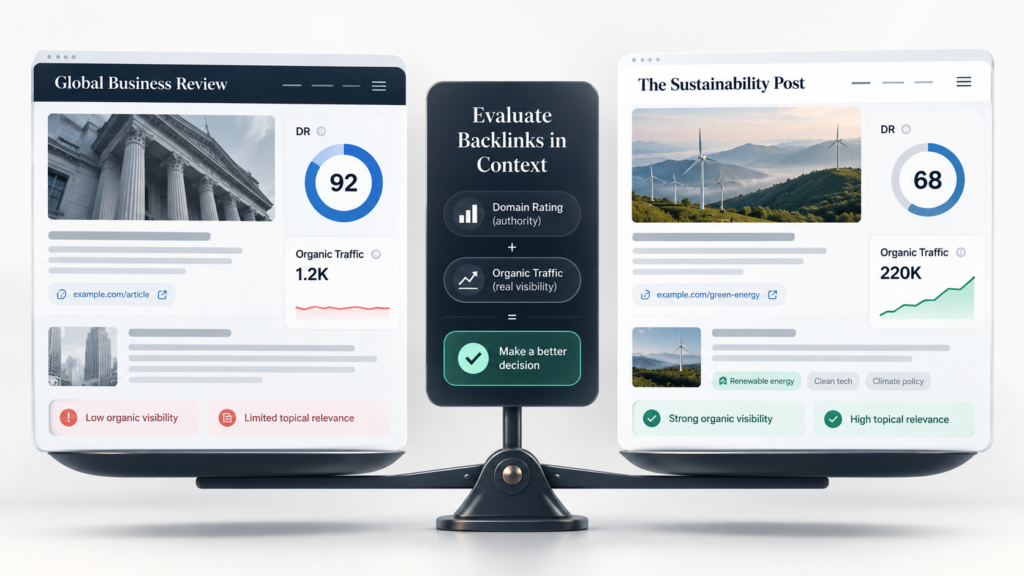
When comparing Domain Rating vs organic traffic for backlinks, neither metric should make the decision on its own.
Domain Rating (DR) tells you how strong a website’s backlink profile is relative to other domains in Ahrefs’ database. Organic traffic estimates tell you whether the site is currently earning search visibility and, with deeper analysis, what that visibility is built on.
They answer different questions.
A site can have DR 70 and almost no meaningful organic traffic. Another can have DR 40 and thousands of relevant monthly visits. The first may have accumulated strong links historically; the second may be a smaller but active publication that ranks for the exact topics your client cares about.
If you are evaluating backlinks, the useful question is not “Which number is bigger?” It is “What does the combination of these signals tell me about this publisher?”
Domain Rating vs Organic Traffic: The Quick Answer
For backlink evaluation, topical relevance and editorial quality come first. Organic traffic is usually the better reality check for whether a publisher has current search visibility, while DR is useful context for the strength of its backlink profile.
If forced to choose between a high-DR site with almost no relevant visibility and a moderate-DR site with stable, relevant organic traffic, the second site will often deserve closer consideration.
But that is not a universal rule. A legitimate publication can have low estimated search traffic because it depends on direct, social, newsletter or news traffic. A high-traffic site can also be a poor backlink source if most of its rankings are irrelevant to your niche.
The right decision uses both metrics, then checks the content, audience, outbound links, site history and exact placement.
What DR and Organic Traffic Actually Tell You
| Signal | What it helps you understand | What it does not prove |
| Domain Rating (DR) | Relative strength of the domain’s backlink profile | Traffic, relevance, readership, editorial quality or placement quality |
| Estimated organic traffic | Current visibility in organic search and the pages/keywords driving it | Exact analytics traffic, backlink strength, brand audience or editorial quality |
| Topical relevance | Whether the publication and placement fit the target site | Authority or real search visibility |
| Editorial quality | Whether the publication behaves like a real publication | How strong its backlink profile is |
What Domain Rating Measures
Domain Rating is a third-party SEO metric created by Ahrefs. It runs from 0 to 100 and is based on the relative strength of a domain’s backlink profile.
That makes DR useful for a specific purpose: understanding how much link authority a domain appears to have accumulated relative to other websites.
It is especially useful when you compare similar publishers in the same niche rather than treating one score as a universal standard.
DR does not directly measure:
- organic traffic
- content quality
- topical relevance
- real readership
- brand reputation
- whether a site sells links heavily
- whether the specific linking page is valuable
That distinction matters because a backlink buyer is not purchasing a DR score. You are evaluating a real website and a real placement.
What Organic Traffic Tells You
Estimated organic traffic is a visibility signal. It helps you understand whether a site currently ranks in search and whether those rankings generate meaningful estimated visits.
For publisher vetting, that makes traffic valuable as a reality check. A website with a strong backlink profile but almost no rankings deserves investigation.
TechBullion makes a similar point in a 2026 link-building article: judging placements by DR alone can hide sites with almost no organic visitors. Its recommendation is to look at real organic visibility alongside relevance and editorial placement.
Organic traffic still needs context. Check:
- which countries generate the traffic
- which pages drive it
- which keywords the site ranks for
- whether traffic is stable, growing or collapsing
- whether rankings match the site’s stated niche
- whether the proposed section of the site receives any visibility
Traffic Quality Matters More Than the Headline Number
A domain showing 100,000 estimated monthly visits can be a worse backlink opportunity than one showing 15,000.
Imagine that the first website earns most of its visibility from celebrity news, song lyrics or unrelated consumer queries, while the second is a focused B2B technology publication ranking for software, cybersecurity and cloud topics.
For a B2B SaaS campaign, the smaller site may provide the better audience and context.
Programming Insider’s recent backlink-value guide makes the same distinction: traffic is useful evidence of visibility, but the raw number can mislead if the ranking topics and audience do not match the site’s purpose or your campaign.
What Does High DR + Low Organic Traffic Mean?
This is one of the most common situations in publisher spreadsheets.
A high-DR, low-traffic domain is not automatically bad. But it should trigger a deeper review.
Possible legitimate explanations include a brand that relies heavily on direct or referral traffic, a publication with content that is not strongly search-oriented, a recent migration, a technical SEO problem, a search-visibility decline, or a domain whose strongest value comes from reputation rather than Google rankings.
Possible negative explanations include an inflated backlink profile, an expired domain repurposed for publishing, a site that has lost most of its rankings, thin or outdated content, or an inventory site created primarily to sell links.
The combination is therefore a diagnostic signal—not a verdict.
How to Investigate a High-DR, Low-Traffic Site
- Look at the 12–24 month organic traffic trend rather than only the current estimate.
- Open the top organic pages and see whether the site still ranks for topics consistent with its brand.
- Check whether the domain recently changed topic or ownership.
- Read recent articles and inspect outbound commercial links.
- Compare the site with genuine competitors in the same niche.
- Evaluate the proposed page or section, not only the root domain.
What Does Moderate DR + High Organic Traffic Mean?
This profile is often attractive because it suggests the publisher has achieved meaningful search visibility without an extreme authority score.
It can indicate strong content, useful topical coverage and pages that Google is willing to surface for real queries.
But it still needs review.
High traffic may be concentrated in a handful of pages, come from countries irrelevant to the campaign, or result from topics unrelated to your client. A large traffic estimate does not automatically mean the link will appear on a page that receives visitors.
Treat it as a strong positive signal when the traffic is relevant, distributed across credible content and consistent with the publisher’s niche.
High DR vs High Traffic: Four Hypothetical Publisher Profiles
| Publisher | DR | Organic traffic | What stands out | Initial decision |
| A | 76 | 700 | Strong backlink profile, very weak visibility | Investigate before approval |
| B | 48 | 32,000 | Moderate authority, strong relevant visibility | Strong candidate if quality/relevance hold |
| C | 61 | 21,000 | Balanced authority and traffic | Strong candidate for deeper review |
| D | 37 | 5,000 | Small specialist publication | Potentially valuable for a tightly relevant niche |
These are illustrative examples, not Mahwords inventory benchmarks or universal thresholds.
So Which Matters More for Backlinks?
If you are choosing backlink opportunities, organic traffic is often the more useful sanity check because it tells you whether the site is currently visible in search.
But DR still matters because traffic and backlink authority are not interchangeable. A site can rank for easy informational queries without having a particularly strong backlink profile, just as a powerful brand can have significant authority while receiving relatively modest estimated search traffic.
The better hierarchy is:
1. Topical and audience relevance
2. Editorial quality and site legitimacy
3. Organic traffic quality and trend
4. Backlink profile strength / DR
5. The exact page and link context
6. Commercial terms and post-publication support
Search Engine Land’s quality-backlink guide reaches a similar conclusion: useful link evaluation goes beyond authority scores and includes relevance, visibility, traffic, editorial context and the wider link profile.
Relevance Can Override Both Metrics
A backlink is not valuable simply because the publisher is large.
Suppose a cybersecurity company can choose between:
- a DR 78 general lifestyle publication with 500,000 monthly visits, or
- a DR 52 cybersecurity and IT publication with 35,000 monthly visits.
The first site wins both headline metrics. The second may still be the stronger placement because its audience, topical context and editorial environment align with the company being linked.
Metrics help qualify opportunities. Relevance determines whether the opportunity makes sense.
Traffic Trend Matters More Than One Snapshot
Never evaluate organic traffic from one number alone.
A site showing 20,000 monthly visits today could be growing from 5,000, stable around 20,000, or falling from 300,000.
Those histories tell different stories.
A decline should not trigger automatic rejection. Search visibility changes because of algorithm updates, seasonality, content decay, site migrations, SERP features and changes in demand.
What matters is whether the trend makes sense when you inspect the site.
Questions to Ask About the Traffic Curve
- Did the decline happen suddenly or gradually?
- Did the site change topic, ownership or URL structure?
- Which pages lost traffic?
- Are new pages still getting indexed and ranking?
- Is the traffic decline isolated to one section or sitewide?
- Do the publisher’s current articles still match the audience you want to reach?
Remember: Third-Party Traffic Is an Estimate
SEO tools estimate organic traffic from keyword rankings, search-volume models and expected click behavior. They do not have access to a publisher’s private analytics unless the publisher has explicitly connected them.
That means you should not treat 18,742 estimated visits as an audited traffic figure.
Use third-party data comparatively:
- Is the site clearly visible or effectively invisible in search?
- Is visibility trending up or down?
- Do multiple tools tell roughly the same story?
- Which countries, keywords and pages create the estimate?
The direction and composition of the traffic are usually more useful than arguing over the exact number.
DR and Traffic Are Only Two Parts of Publisher Quality
A backlink decision still needs human review.
Before approving a guest post or link insertion, look at the publication itself: content quality, topical focus, authors, outbound links, publishing patterns, domain history and the exact page where your link will appear.
Mahwords’ full guide on how to evaluate a guest post site before buying a backlink covers that review process in detail.
How Agencies Should Read Publisher Spreadsheets
Publisher lists often encourage the wrong behavior because DR and traffic sit in neat columns and can be sorted instantly.
That makes it tempting to create rules such as:
- DR 50+ only
- 10,000+ traffic only
- reject every declining site
- pay more automatically for higher DR
Those rules are easy to operationalize, but they can remove excellent niche publishers and admit weak sites that happen to pass a numeric filter.
A better workflow uses metrics to create a shortlist, then reviews the actual publications.
If your agency receives inventory from a white-label link-building partner, the provider should give you enough information to make that judgment before the placement is completed.
A Practical Mahwords Decision Framework
When DR and organic traffic point in different directions, use this sequence rather than trying to pick a universal winner.
1. Relevance — Does the publication genuinely cover the client’s topic or reach a useful adjacent audience?
2. Organic visibility — Does the site rank, where does the traffic come from, and is the trend credible?
3. Backlink strength — Does the DR/referring-domain profile support the apparent authority of the site?
4. Editorial quality — Would you be comfortable showing the publication to the client without explaining away the content?
5. Outbound-link behavior — Does the site link editorially, or does every recent article look like inventory?
6. Placement fit — Does the actual article/page make sense for the target URL and anchor?
When to Prefer DR, Traffic or Neither
| Situation | What deserves more weight | Why |
| Two highly relevant sites with similar traffic | DR/backlink strength | It can help distinguish relative authority once other signals are comparable |
| High DR but almost no visibility | Organic traffic + manual review | The mismatch needs explanation before approval |
| Moderate DR with strong relevant visibility | Traffic + relevance | The site demonstrates current topical visibility |
| Huge traffic from unrelated topics | Neither headline number | Traffic quality and placement relevance matter more |
| Major recognized publication with low SEO-tool traffic estimate | Brand/editorial context | Search estimates may understate non-search audience and reputation |
| Obvious link-selling or multi-niche inventory site | Neither | Strong numbers do not repair weak editorial legitimacy |
Do Not Turn Either Metric Into a Universal Cutoff
Rules such as “never buy below DR 50” or “never use a site under 10,000 traffic” sound disciplined, but they ignore how different industries behave.
A narrow industrial-software publication may have a small but commercially valuable audience. A broad entertainment site can attract huge traffic without being useful to a B2B campaign.
Thresholds are most useful when they are campaign-specific.
For example, an agency may require stronger minimum traffic for broad marketing placements but allow lower traffic when the site is an unusually relevant specialist publication.
What This Means for Your Link-Building Strategy
Metrics should reduce research time, not replace judgment.
Use DR to understand backlink strength. Use organic traffic to test current search visibility. Use relevance, editorial quality and placement context to decide whether the backlink belongs in the campaign.
That keeps you from making two expensive mistakes: overpaying for high-DR domains with little real value, and rejecting strong niche publishers because their authority score looks modest.
For the wider acquisition framework, see Mahwords’ complete guide to link building.
How Mahwords Uses DR and Organic Traffic
Mahwords treats DR and organic traffic as screening signals rather than standalone definitions of publisher quality.
Publisher opportunities are reviewed for niche fit, authority metrics, organic visibility, target-page relevance, placement type and editorial rules before a campaign moves forward.
The practical objective is to make the tradeoff visible before the buyer commits: which publisher is being proposed, what its metrics look like, what type of placement is available and whether it fits the campaign.
The Better Question Is Not DR or Traffic
Domain Rating and organic traffic measure different things.
DR tells you about backlink-profile strength. Organic traffic tells you about estimated search visibility.
Neither tells you whether the publisher is relevant, editorially credible or appropriate for your exact placement.
If you see high DR and weak traffic, investigate the mismatch. If you see strong traffic and modest DR, examine whether the visibility is relevant and sustainable. If both metrics look strong, still read the site before approving it.
The strongest backlink opportunities are usually the ones where the numbers and the publication tell the same story.
Need to compare publisher options using relevance, DR, organic traffic and placement fit before you commit? Review the available opportunities with Mahwords before fulfillment.
Frequently Asked Questions
Is Domain Rating or organic traffic more important for backlinks?
Neither should be used alone. For publisher evaluation, organic traffic is often the better reality check for current search visibility, while DR provides useful context about backlink-profile strength. Relevance, editorial quality and the actual placement should ultimately decide the opportunity.
Is a high-DR site with low traffic bad?
Not automatically. It may be a legitimate brand with limited search visibility, a publication driven by direct or referral traffic, or a site going through a traffic decline. It can also indicate an inflated or deteriorated domain. Investigate the traffic trend, ranking pages, backlink profile, content and site history before deciding.
Can a low-DR website still be a good backlink source?
Yes. Newer and specialist publications can have modest DR while reaching a highly relevant audience and ranking well for niche topics. Low DR is not a spam score.
How much organic traffic should a backlink site have?
There is no universal minimum. Traffic expectations should reflect the niche, geography and campaign. A specialized B2B publication may naturally receive much less search traffic than a general consumer site while still being a better backlink opportunity.
Why can a website have high DR but almost no organic traffic?
DR is primarily based on backlinks, while organic traffic depends on rankings and search demand. A site can retain a strong backlink profile while losing rankings, changing topic, publishing weak content or relying on non-search audiences.
Should I pay more for a higher-DR guest post?
Not automatically. Higher DR can support a higher valuation when relevance, traffic, editorial quality and placement conditions are otherwise comparable. It should not justify a premium by itself.