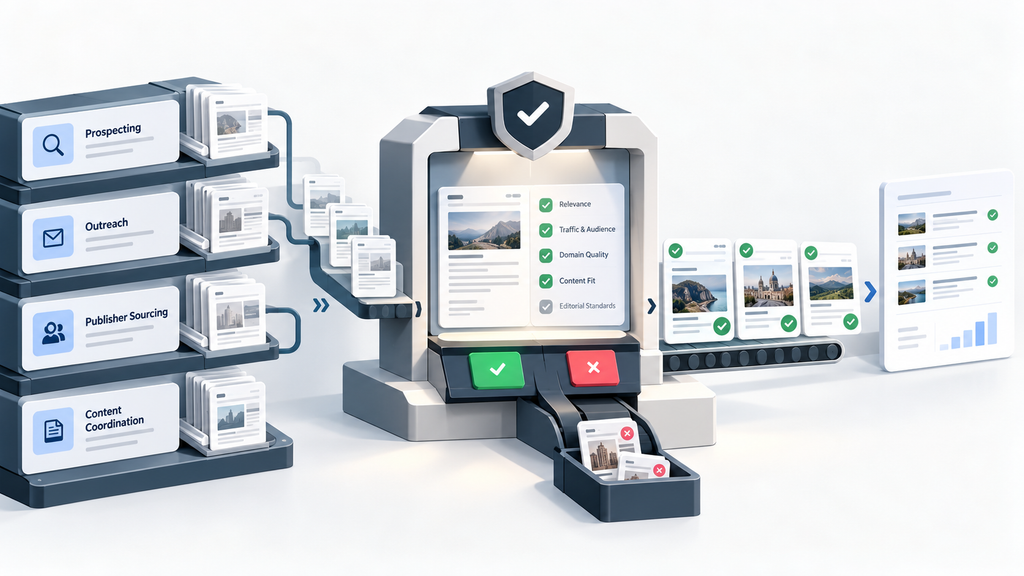
If you want to outsource link building without losing quality control, the safest model is simple: outsource the execution, not the judgment.
Prospecting, outreach, publisher communication, content coordination, placement management and reporting can all be delegated. Your business should still control the strategy, target pages, quality standards, anchor rules, approval thresholds and final accountability.
The mistake is not outsourcing. The mistake is handing a provider a monthly link quota and discovering what they built only after the links are live.
A strong outsourcing setup reduces workload while keeping visibility. A weak one replaces an internal bottleneck with a black box.
What Does It Mean to Outsource Link Building?
Outsourcing link building means delegating some or all of the operational work involved in acquiring backlinks to an external freelancer, specialist agency, marketplace, or fulfillment partner.
That operational work can include:
- competitor and backlink-gap research;
- prospect discovery;
- publisher qualification;
- contact research;
- outreach and follow-ups;
- publisher negotiation;
- content writing and editing;
- guest-post or link-insertion coordination;
- live-placement verification;
- campaign tracking and reporting;
- post-publication support.
Outsourcing does not have to mean transferring every decision. In many of the strongest arrangements, the buyer keeps strategic control while the provider handles the repetitive and relationship-heavy work required to execute the campaign.
For agencies reselling the work under their own brand, that model often overlaps with white-label link building, where the fulfillment partner stays behind the scenes while the agency owns the client relationship.
The Core Rule: Outsource Work, Not Judgment
The safest way to structure outsourced link building is to separate decisions that require business context from tasks that benefit from specialist execution.
| Keep control of | Can usually be outsourced |
| SEO and authority strategy | Prospecting and publisher research |
| Target-page priorities | Contact discovery |
| Client or brand risk tolerance | Outreach and follow-up |
| Quality standards | Publisher communication |
| Anchor governance | Content coordination |
| Final publisher approval | Placement logistics |
| Budget allocation | Initial placement QA |
| Campaign-level performance decisions | Reporting data and live-URL delivery |
| Final accountability | Agreed replacement/support workflow |
The exact boundary can change. An experienced in-house SEO team may keep strategy and approvals while outsourcing almost everything else. A smaller company may ask a specialist agency to recommend targets and anchors as part of a managed campaign.
The important part is that responsibility is explicit. If nobody knows who owns publisher approval, anchor decisions, content review or replacement disputes, quality tends to fail at the handoff points.
When Outsourcing Link Building Makes Sense
Outsourcing is usually an operating-capacity decision, not an admission that the internal team cannot do SEO.
Your team understands link building but lacks capacity
This is often the cleanest use case. The internal team knows what good publishers and sensible anchors look like, but it cannot maintain prospecting, outreach, negotiation and content coordination at the required volume.
In that situation, an external partner can add throughput without replacing the team that sets standards.
You need publisher relationships in niches you do not cover
A team that performs well in SaaS may not have relationships in cybersecurity, finance, ecommerce or professional services. Outsourcing can provide access to additional publisher pipelines without forcing the company to build every niche from zero.
Demand is variable
Hiring permanent outreach capacity for temporary client spikes can create idle overhead later. An external partner can be used as overflow capacity during heavy campaign periods and reduced when demand falls.
You want to add link building before hiring a full team
Agencies sometimes want to validate demand for a service before hiring researchers, outreach specialists, writers and publisher managers. Outsourcing can let the agency test the commercial model first.
The operational work is distracting senior SEO staff
If strategists spend most of their week checking inboxes, negotiating placements and updating spreadsheets, the company may be using expensive strategic time for work that can be systematized elsewhere.
When You Should Keep More Link Building In-House
Outsourcing is not automatically the better model.
Keep more of the function internally when:
- your proprietary outreach process is a core reason clients hire you;
- the campaign depends on direct journalist, creator or industry relationships;
- you cannot yet define what a good backlink looks like for the campaign;
- the subject matter is sensitive enough that external outreach creates brand risk;
- the work requires deep product or technical expertise that a provider cannot reliably represent;
- your team needs to build long-term relationship equity rather than simply acquire placements.
You can also run a hybrid model: keep high-value digital PR, relationship-led outreach or strategic accounts internally while outsourcing repeatable prospecting and publisher fulfillment.
How to Outsource Link Building Without Losing Quality Control
Quality control should be designed into the engagement before the first prospect is contacted. It is much harder to repair a campaign after dozens of weak placements have already gone live.
1. Define the campaign before choosing the provider
Start with what the links are supposed to accomplish.
Document:
- target pages;
- priority markets;
- relevant topics and niches;
- acceptable placement types;
- quality thresholds;
- anchor rules;
- prohibited industries or site types;
- content requirements;
- monthly capacity;
- budget range;
- approval process;
- reporting requirements.
This prevents the provider from optimizing for the easiest metric to deliver—usually link count—rather than the campaign requirement.
If the wider acquisition strategy is still unclear, define that first. Publisher sourcing should sit inside a broader link-building strategy, not replace one.
2. Write the quality rules before outreach starts
Do not tell a provider to deliver “high-quality links.” Define what that means.
Your brief might include requirements around:
- topical relevance;
- minimum or preferred organic visibility;
- traffic geography;
- traffic trend;
- editorial standards;
- site history;
- outbound-link behavior;
- backlink-profile quality;
- placement context;
- content quality;
- link attributes;
- excluded niches.
Avoid turning those requirements into a single-metric rule such as “DR 50+ only.”
Ahrefs itself says a website should not be judged on site-wide authority alone and recommends also looking at backlinks, content quality, organic traffic, topical relevance and outbound linking. See its Domain Rating guidance.
Mahwords uses the same principle in its guide on how to evaluate a guest post site: metrics help filter opportunities, but the publisher and the actual placement still require editorial judgment.
3. Require publisher transparency
You should know what kind of supply model the provider uses.
Common models include:
- existing publisher inventory;
- custom outreach;
- marketplace sourcing;
- direct publisher relationships;
- a mix of inventory and outreach.
None is automatically superior. The risk appears when the provider cannot explain where opportunities come from or refuses to give enough information for meaningful approval.
For managed campaigns, transparency does not necessarily mean revealing every prospect before outreach begins. It means creating a clear approval point before a questionable placement becomes your problem.
4. Use pre-approval for placements that matter
The strongest quality-control mechanism is simple: review the publisher before the link goes live.
A useful approval record can include:
| Field | Why it matters |
| Publisher/domain | Lets you inspect the actual site |
| Topical category | Checks relevance |
| Estimated organic traffic | Adds visibility context |
| Main traffic country | Checks geographic fit |
| Traffic trend | Shows whether visibility is stable or collapsing |
| Authority metric | Useful as one comparative signal |
| Placement type | Guest post, insertion, PR, etc. |
| Proposed topic/page | Lets you evaluate placement-level relevance |
| Price or campaign allocation | Lets you judge commercial value |
Pre-approval slows fulfillment slightly. That is usually a good trade when the alternative is removing or replacing a bad placement later.
5. Keep anchor governance centralized
Anchor text should not be whatever the provider finds easiest to place.
Give the provider a clear system for:
- brand anchors;
- URL anchors;
- partial-match anchors;
- descriptive anchors;
- when exact-match language is prohibited or restricted;
- which target URL each anchor can support.
The goal is not to engineer a mechanical percentage mix. It is to prevent repetitive, unnatural commercial anchors from appearing across unrelated placements.
Google’s spam policies list buying or selling links for ranking purposes and certain optimized-anchor guest-post arrangements as link spam. That policy risk exists regardless of whether the campaign is handled internally or outsourced.
6. Control the content standard
Poor outsourced content can undo an otherwise good publisher decision.
Clarify:
- who writes the draft;
- whether subject-matter expertise is required;
- who reviews factual claims;
- whether the client or agency can edit the article;
- whether the publisher rewrites content;
- minimum editorial requirements;
- how the target link should fit the surrounding paragraph.
The link should make sense because the article makes sense—not because someone needed somewhere to place an anchor.
7. QA every delivered placement
Outsourcing should reduce execution workload, but the buyer still needs a lightweight verification process.
For every delivered link, confirm at least:
- the URL is live;
- the correct target URL is linked;
- the anchor matches the approved plan;
- the article/page is the one that was approved;
- the surrounding context is relevant;
- the agreed link attribute is present;
- the page is accessible;
- the publisher has not made obvious post-approval changes.
This can be done quickly when reporting is structured correctly. It becomes expensive when the provider sends inconsistent spreadsheets or vague monthly summaries.
8. Define reporting before the campaign
A useful outsourced link-building report should make every placement independently verifiable.
| Reporting field | Purpose |
| Live URL | Confirms the placement exists |
| Publisher | Identifies the referring site |
| Target URL | Confirms the correct destination |
| Anchor text | Verifies implementation |
| Placement type | Distinguishes guest posts, insertions, PR, etc. |
| Publication date | Tracks delivery timing |
| Relevant publisher metrics | Provides quality context |
| Status | Tracks live, changed, dropped or replaced links |
| Notes | Documents exceptions or publisher changes |
Do not confuse reporting with measurement. A placement report tells you what was delivered. Campaign measurement should separately examine rankings, referring domains, organic visibility, conversions or other objectives that matter to the SEO strategy.
9. Agree on replacement and support rules
Links can disappear. Publishers can edit pages. URLs can redirect. Attributes can change.
Before the campaign starts, define:
- what counts as a dropped or materially changed placement;
- how long support lasts;
- whether the provider replaces the same domain or uses another publisher;
- whether content fees are covered in a replacement;
- what happens if a page never becomes discoverable;
- which outcomes are outside the provider’s control.
Do not accept guarantees for rankings, traffic or permanent Google indexation. Those outcomes are not fully controlled by the provider.
10. Start with a controlled test
Do not move an entire client portfolio to a provider because the sales deck looks good.
A small paid test can reveal:
- publisher quality;
- communication speed;
- ability to follow a brief;
- content quality;
- accuracy of reporting;
- how revisions are handled;
- whether timelines are realistic;
- whether the partner takes responsibility when something goes wrong.
The objective of the test is not to negotiate the cheapest possible trial. It is to observe the operating system before increasing volume.
Four Common Ways to Outsource Link Building
“Outsourcing” covers several different delivery models. The right one depends on how much management you want to retain.
| Model | You usually retain | Best fit |
| Freelancer | Strategy, QA, workflow management | Teams with link-building expertise but insufficient execution capacity |
| Marketplace | Almost everything except publisher access | Experienced buyers making selective one-off purchases |
| Specialist link-building agency | Goals, approvals and performance oversight | Brands wanting managed execution |
| White-label fulfillment partner | Client relationship, strategy and approval rules | SEO/digital agencies reselling fulfillment |
Freelancers
Freelancers can be excellent for specific components such as prospecting, outreach or campaign management. The tradeoff is continuity and management: your team normally needs to provide a tighter operating system.
Marketplaces
Marketplaces make publisher discovery and purchasing easier, but they often transfer much of the quality-control burden back to the buyer. If your team cannot independently evaluate sites, a large inventory is not automatically useful.
Specialist agencies
A specialist agency can own more of the campaign, including prospecting, outreach, content and reporting. This reduces internal management but increases the importance of transparency, approval rules and provider accountability.
White-label partners
White-label partners are designed for agencies that need backend fulfillment while keeping the client-facing relationship. The provider may be invisible to the end client, but it should never be invisible to the agency buying the work.
How to Evaluate an Outsourced Link-Building Provider
A provider should be evaluated on process, not only on examples of links it has built.
Ask these questions before increasing volume:
| Area | Question to ask |
| Sourcing | Where do publisher opportunities come from? |
| Relevance | How do you decide whether a publisher fits the client? |
| Traffic | Do you review current visibility and traffic trends? |
| Authority | Which metrics do you use, and what do you use besides them? |
| Approval | Can we approve or reject publishers before placement? |
| Outreach | Is outreach custom, inventory-led, marketplace-led, or mixed? |
| Content | Who writes and reviews the content? |
| Anchors | Who approves anchor text and target pages? |
| Reporting | Do we receive live URLs and enough data to verify each link? |
| Support | What happens when a link disappears or changes? |
| Confidentiality | Will you ever contact our clients directly? |
| Scale | What changes operationally when volume doubles? |
Ahrefs’ guide to outsourcing SEO similarly highlights quality, provider fit and low-quality links as central risks when link building is outsourced.
Its guide to hiring a link-building agency also emphasizes transparency, realistic timelines, communication and accountability—useful criteria regardless of whether you hire an agency, freelancer or fulfillment partner.
Red Flags in Outsourced Link Building
The provider sells a link count, not a process
“20 links per month” tells you nothing about relevance, publisher quality, content, approval or how those links were acquired.
You cannot reject publishers
If the provider controls the inventory and also decides what counts as acceptable, the buyer has no meaningful quality-control checkpoint.
Quality is defined only by DR or DA
Third-party authority metrics are useful signals, not editorial quality scores.
Every niche is available instantly
Broad supply is possible, but near-unlimited instant inventory across every industry deserves scrutiny.
The provider guarantees rankings
A provider can control its process. It cannot control Google’s rankings.
You receive links but no context
A URL-only report makes it difficult to verify anchors, target pages, dates, placement types and changes.
The provider cannot explain what happens when a link drops
Support terms should be known before the first placement, not negotiated after a problem appears.
There is pressure to scale before testing
A provider confident in its workflow should be comfortable proving it on a controlled initial campaign.
What Should Outsourced Link Building Cost?
There is no meaningful universal price because “outsourced link building” can describe anything from a freelancer running outreach to a fully managed campaign with strategy, content, publisher coordination, QA and support.
When comparing quotes, separate the publisher or placement cost from the service layer around it.
Ask whether the quote includes:
- prospecting;
- outreach;
- publisher fees;
- content writing;
- editing;
- strategy;
- quality review;
- client-specific approvals;
- reporting;
- post-publication support.
A cheaper quote can become more expensive if your internal team must spend hours vetting every publisher, rewriting content and repairing reports.
Likewise, a managed provider is not automatically worth more simply because it bundles more services. The underlying publishers and placements still need to justify the price.
How to Measure an Outsourced Link-Building Partner
Do not evaluate the relationship only by the number of links delivered.
A useful scorecard can track:
- percentage of proposed publishers approved;
- percentage rejected and why;
- on-time delivery rate;
- content revision rate;
- placement accuracy;
- link survival;
- replacement frequency;
- average turnaround by placement type;
- communication responsiveness;
- campaign-level SEO outcomes over time.
The first eight are operational measures. Rankings and organic performance are strategic outcomes influenced by many factors beyond the provider.
Separating the two prevents the team from blaming the fulfillment partner for every ranking change—or ignoring obvious delivery problems because rankings happened to rise.
What About Google’s Rules?
Outsourcing itself is not the policy issue. The link-acquisition method is.
Google’s spam policies classify buying or selling links for ranking purposes as link spam. The examples include exchanging money for links or posts containing links and certain paid guest-post or advertorial arrangements that pass ranking credit.
Google separately says paid advertising or sponsorship links should be qualified appropriately, with rel=”sponsored” or rel=”nofollow”.
That is Google’s documented policy.
Industry practice is broader, and many commercial link-building providers sell followed placements intended for SEO. Outsourcing the work does not make those arrangements more or less compliant.
A serious provider should be able to explain how links are acquired, whether compensation is involved, what link attributes are used and what it is promising—without pretending that all paid backlinks are “safe.”
A Practical Outsourcing Workflow
For most agencies and in-house teams, the following sequence keeps quality control manageable:
- Define the SEO objective and target pages.
- Write publisher and placement quality rules.
- Choose the outsourcing model: freelancer, marketplace, specialist agency or white-label partner.
- Run a small paid test.
- Review proposed publishers before placement.
- Approve anchors, targets and content requirements.
- Verify every live placement.
- Track dropped or changed links.
- Review operational performance monthly.
- Increase volume only after the provider proves consistency.
This may feel slower than sending a provider a budget and asking for as many links as possible.
It is also much easier to scale.
Once the standards and approval workflow are stable, more of the repetitive work can move outside the company without giving up visibility.
How Mahwords Approaches Outsourced Fulfillment
Mahwords is designed to support agencies and businesses that need publisher-side capacity without turning fulfillment into a black box.
The operating model can include:
- campaign requirements and niche filters;
- publisher sourcing;
- publisher pre-approval;
- guest posts and contextual link insertions;
- content support where needed;
- live-URL verification;
- post-publication support;
- recurring or volume fulfillment;
- founder-led communication.
The buyer still decides whether the opportunity fits the campaign.
That is the point of quality-controlled outsourcing: remove the publisher-management workload without removing the buyer’s ability to say no.
The Practical Answer
Should you outsource link building?
Outsource it when execution is the bottleneck and you can clearly define the standard the provider must meet.
Keep more of it in-house when the strategy itself is unclear, the relationships are strategically important, or your team cannot yet evaluate the work it would be buying.
The strongest outsourcing model is not the one that removes your involvement completely.
It is the one that removes repetitive execution while preserving the decisions that protect quality.
Need additional publisher capacity without giving up placement approval? Request publisher options from Mahwords and review the opportunities before fulfillment.
Frequently Asked Questions
Is it a good idea to outsource link building?
It can be when your team understands its SEO goals and quality standards but lacks execution capacity, publisher relationships or time. Outsourcing is riskier when the buyer cannot independently evaluate publisher and placement quality.
What parts of link building should I outsource?
Prospecting, contact research, outreach, follow-ups, publisher communication, content coordination, placement tracking and reporting are commonly outsourced. Strategy, target-page priorities, risk tolerance, quality rules and final accountability should usually remain with the business or agency.
How do I maintain quality when outsourcing link building?
Document quality criteria before outreach begins, require publisher transparency, use pre-approval, control anchors and target URLs, review content standards, verify every live placement and define replacement terms in advance.
Should I outsource link building to a freelancer or agency?
Freelancers can work well when you already have strategy and management capacity. Specialist agencies are better suited to teams that want more of the campaign managed. Agencies reselling the work may prefer white-label fulfillment.
How can I tell if an outsourced link-building provider is trustworthy?
Look for transparent sourcing, realistic timelines, clear publisher-vetting criteria, pre-approval options, verifiable reporting, written support terms and willingness to explain failures or rejected opportunities.
Can a provider guarantee rankings from backlinks?
No credible provider controls Google rankings. A provider can commit to its acquisition process, quality criteria, placement delivery and agreed support terms, but rankings depend on many factors.
Is outsourced link building against Google’s guidelines?
Outsourcing is not itself a violation. Google’s policies focus on how links are acquired. Google classifies buying or selling links for ranking purposes as link spam and says paid advertising or sponsorship links should be appropriately qualified.